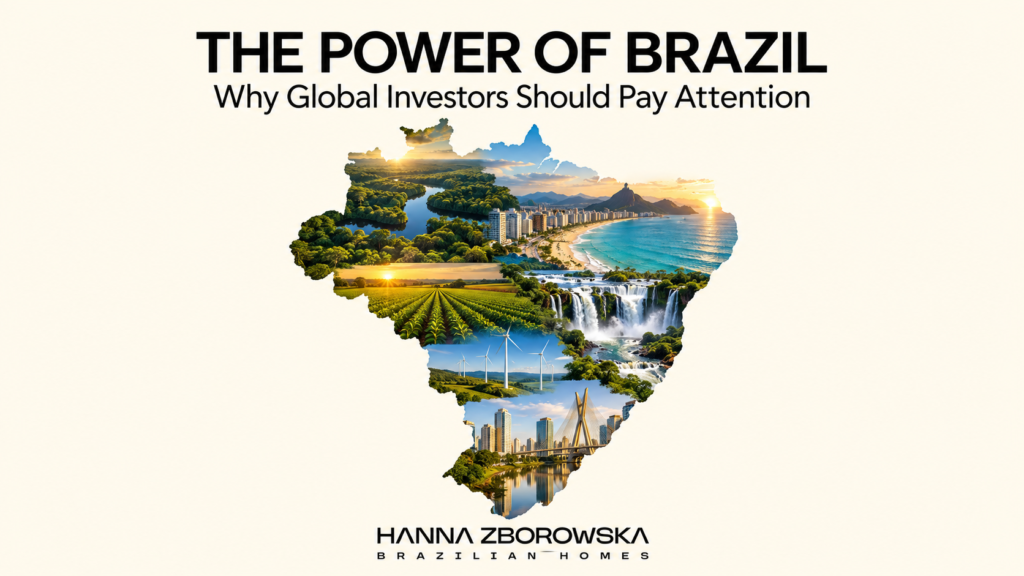
The Power of Brazil: Why Global Investors Are Looking South
Read More
The Power of Brazil: Why Global Investors Are Looking South
Brazil is usually introduced to the world through familiar images: Carnival, football, beaches, Rio de Janeiro and the Amazon. They are all part of the country, but they do not explain why Brazil is becoming increasingly important to the global economy.
The more interesting story lies beneath the surface.
Brazil combines productive land, freshwater, renewable energy, minerals, biodiversity and a domestic market of more than 200 million people. Few countries possess so many strategic resources within one territory.
At a time when governments and companies are concerned about food security, access to water, energy supplies, climate resilience and critical minerals, Brazil finds itself in a remarkable position. Many of the assets the world will need most over the coming decades already exist here in abundance.
A continental country with a major economy
Brazil covers approximately 8.5 million square kilometres and is the fifth largest country in the world by area. Its size is difficult to appreciate until you travel across it. The country contains enormous cities, agricultural regions, tropical forests, wetlands, mountains, deserts, dunes and nearly 7,500 kilometres of Atlantic coastline.
It is also one of the largest economies in the world, with a population exceeding 200 million people and a vast domestic consumer market.
In its July 2026 assessment, the International Monetary Fund described the Brazilian economy as remarkably resilient despite multiple external shocks. It also projected that economic growth could strengthen to around 2.5% over the medium term.
Economic rankings, however, tell only part of the story. Brazil’s true strategic importance becomes clearer when we consider what the country actually possesses.
Brazil can help feed the world
Driving through the Brazilian countryside gives you a sense of scale that statistics alone cannot capture. Fields seem to continue endlessly. Depending on the region, you may see soybeans, corn, coffee, sugarcane, cotton, fruit or cattle stretching towards the horizon.
Brazil has built one of the most advanced agricultural sectors in the world. It combines extensive productive land with research, technology and favourable growing conditions. In many areas, farmers can produce more than one crop during the same year.
During the 2024/25 season, Brazil harvested a record 352.2 million tonnes of grains. In 2025, Brazilian agribusiness exports reached approximately US$169.2 billion, representing 48.5% of the country’s total export value. The agricultural trade surplus was close to US$149 billion.
Soybean exports reached a record 108.2 million tonnes. Beef exports also achieved record levels, while coffee generated approximately US$16 billion in export revenue.
These figures matter because food security is no longer simply an agricultural issue. It has become an economic and geopolitical concern.
Countries can build factories, financial centres and technology companies. What they cannot easily create is millions of hectares of productive land with sufficient sunlight, rain and suitable temperatures to sustain agriculture on Brazil’s scale.
Water may be Brazil’s most valuable resource
Freshwater is one of Brazil’s greatest and most underestimated assets.
The country contains much of the Amazon basin, one of the largest river systems on Earth, as well as significant underground water reserves. Brazil also shares major aquifer systems, including the Guarani Aquifer, with neighbouring countries.
As water scarcity becomes a growing concern in many regions, access to reliable freshwater supplies will influence where food can be produced, where industries can develop and where populations can grow.
Water should therefore be understood as more than an environmental resource. It is also economic and strategic capital.
It connects directly to another important Brazilian advantage: energy.
Brazil already has one of the cleanest electricity systems among major economies
Brazil begins the global energy transition from a very different position than countries that depend heavily on imported fossil fuels.
According to Brazil’s Energy Research Office, renewable sources produced 86.8% of the country’s electricity in 2025. Hydropower remains an important part of the system, but wind and solar power are expanding quickly.
Together, wind and solar generated 26.4% of Brazilian electricity in 2025. Solar generation increased by almost 25% in one year, while wind generation grew by more than 8%.
This opportunity is particularly visible in Northeastern Brazil.
Living in Ceará makes the potential easy to understand. We have extraordinary levels of sunshine and strong, consistent Atlantic trade winds. The same winds that transformed Ceará into one of the world’s best destinations for kitesurfing and other wind sports also make the region highly attractive for renewable energy production.
Brazil can combine hydropower, wind, solar, biomass and biofuels with significant oil and natural gas reserves. This variety gives the country greater flexibility and energy security than economies dependent on a single source.
The wealth beneath Brazilian soil
Brazil’s natural wealth is not limited to agriculture, water and energy. Beneath its soil lie major deposits of iron ore, bauxite, manganese, nickel, gold, graphite and other strategically important minerals.
The country also has significant potential in minerals required for batteries, electrification and advanced technologies. Its rare earth reserves are attracting growing international attention.
This matters because the next stage of the global economy will require enormous quantities of critical minerals. Electric vehicles, energy storage systems, renewable infrastructure and electronic devices all depend on them.
Governments and international companies are now looking for ways to diversify their supply chains and reduce dependence on a small number of suppliers. Brazil already possesses many of the resources they are seeking.
Geography is another Brazilian advantage
Brazil lies largely within the interior of the South American tectonic plate. It is not positioned along one of the planet’s major active plate boundaries.
As a result, the country does not normally experience the destructive earthquakes found in places such as Chile, Japan, Indonesia or Turkey. Brazil has no currently active volcanoes and is not regularly exposed to the powerful hurricane landfalls experienced in the Caribbean, the Gulf of Mexico and parts of the United States.
This does not mean that Brazil is free from natural disasters. Floods, droughts, landslides, wildfires and extreme rainfall can cause serious damage, and climate change is increasing several environmental risks.
Even so, Brazil’s geological location eliminates certain categories of catastrophic risk that remain a permanent concern in many other countries. For investors making decisions for decades rather than months, this matters.
Nature is becoming an economic asset
Brazil contains ecosystems that do not exist anywhere else at a comparable scale. The Amazon, the Cerrado, the Atlantic Forest, the Pantanal and the Caatinga form part of an extraordinary natural heritage.
The country also offers vast river systems, tropical forests, wetlands, mountains, dunes and thousands of kilometres of coastline.
For much of history, natural wealth was measured mainly by how much could be extracted from it. That calculation is beginning to change.
Forests, freshwater, biodiversity, carbon storage and renewable energy potential increasingly have economic value of their own. Brazil possesses all of them.
This does not remove the need for responsible development. On the contrary, Brazil’s challenge is to protect its natural assets while using them intelligently to generate employment, infrastructure and prosperity.
Brazil is not dependent on one advantage
Perhaps Brazil’s greatest strength is its diversification.
The country has agriculture and minerals, oil and renewable energy, freshwater and productive land. It has a large domestic market as well as a powerful export economy. It contains industrial centres, agricultural regions, global cities and some of the most important natural ecosystems on the planet.
Few countries can offer this combination at the same scale.
Brazil also has serious challenges. Bureaucracy, taxation, infrastructure gaps, inequality, public security, fiscal pressure and political volatility cannot be ignored. Any honest investment analysis must acknowledge them.
But these challenges coexist with an extraordinary collection of fundamental assets. Governments change, currencies fluctuate and interest rates move through cycles. Fertile land, freshwater, mineral reserves and thousands of kilometres of Atlantic coastline do not disappear with the next election.
What this means for Brazilian real estate
This is where the subject becomes especially relevant to me.
I have lived in Brazil for 20 years and worked in the real estate market for 17 years. During that time, I have seen how many international buyers evaluate a Brazilian property without fully considering the country behind it.
Real estate is never only about square metres. When you purchase a property, you are also investing in a city, a region and an economy.
Brazil offers international buyers access to one of the world’s major economies together with a lifestyle that is becoming increasingly difficult to find elsewhere. Space, nature, warm weather, outdoor living and a long coastline remain available at prices that can be very attractive compared with many European and North American markets.
Ceará is a particularly interesting part of this story.
Fortaleza is a major Brazilian city located directly on the Atlantic Ocean. Beyond the capital, the coast continues through destinations such as Cumbuco, Taíba, Flecheiras, Guajiru, Icaraizinho and Preá. These places are attracting growing international attention because of their beaches, wind sports, lifestyle and investment potential.
The same natural conditions that make Ceará appealing to residents and visitors also create economic opportunities. The ocean supports tourism and quality of life. The sun and wind support renewable energy. International flight connections make Fortaleza more accessible to Europe and other parts of the world.
This combination of lifestyle, tourism, natural resources and economic activity is one reason Northeastern Brazil deserves closer attention.
Why the world is starting to look south
For decades, global economic power was associated mainly with manufacturing, finance, technology and fossil fuels. These sectors remain essential, but the next decades will introduce additional priorities.
The world will need countries that can produce food, provide freshwater, generate reliable energy and supply the minerals required for new technologies. It will also place greater value on productive land, biodiversity and climate resilience.
Brazil has a strong answer to almost every one of these needs.
Its importance does not come from a single resource. It comes from the rare combination of nearly all of them within one continental economy.
That is the real power of Brazil, and it is why global investors are beginning to pay closer attention.
Hanna Zborowska
Real Estate in Fortaleza and Ceará, Brazil
www.hannazborowska.com